Is AI biased?
AI never went to school. It learned everything from piles and piles of examples people put online. So here's the catch: if a pile was uneven, AI learned the uneven version too. Then it repeats it — so sure of itself, like it's just the truth.
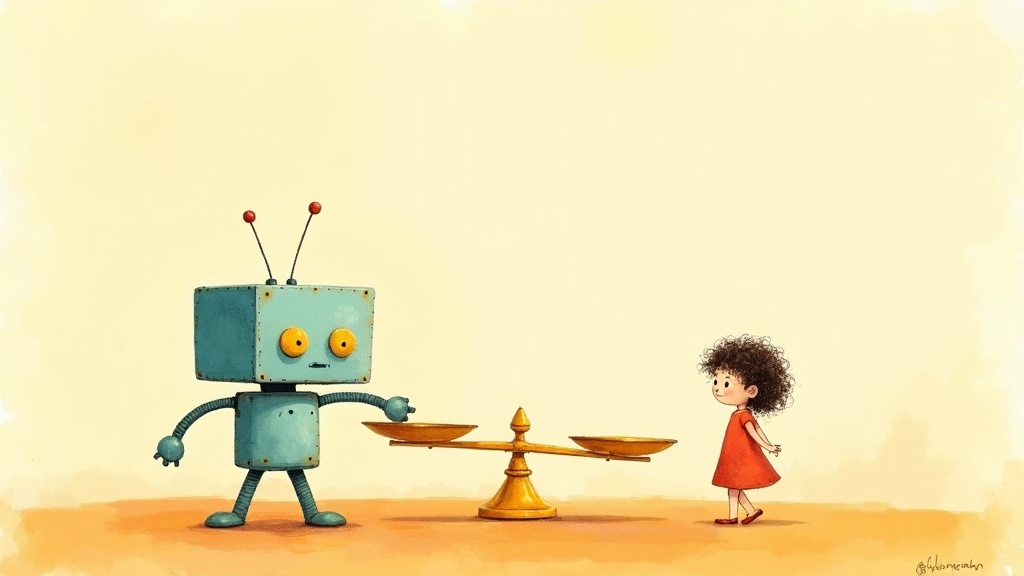
Who does AI picture?
First, the fair part: in real life, a doctor, a nurse, a scientist, or a hero can be anyone — any gender, any size, any color. Here's the catch, though: when you give an AI just the word, it often doesn't guess "anyone." It copies whoever it saw most in its giant pile of pictures. Tap a card to see which way the AI leans — and notice that you already know the fairer answer. Catching that lean is the whole skill.
AI didn't choose to draw a man. It just saw way more men labeled "doctor," so that's the guess it copies. Here's the sneaky part: AI sounds so sure that it's easy to believe. But what AI usually draws isn't the same as what's true — or what's fair. Noticing that is the whole trick.
Where did it learn that?
Where does an AI's bias come from? Let's catch it in the act.
Bias means letting "most" quietly turn into "all." Golden retrievers might be the most popular dog — but you wouldn't want to learn that every dog is a golden retriever. That mistake is a bias.
So let's catch it in the act — with dogs, because it's easy to see. Here's the pile of "dog" pictures an AI learned from. Look how many are the same:
If AI forgets about poodles, that's not a huge deal — well, maybe to a poodle owner! But the same lean with people is a real problem: ask it to draw a "doctor" and it usually draws a man, because that's who filled its pile. And it can stick: the more AI shows "doctor = man," the more normal it looks — so the pile stays lopsided. That way, one wrong guess keeps repeating itself, and nobody ever decided it should.
So copying isn't good enough. We want AI to show what's possible: a dog can be any breed, and a doctor can be anyone. The fix is people — humans who notice the lean and even out the pile. That's a real job, and it's why YOU spotting "hey, that's a lean!" actually matters.
"Usual" is not the same as "fair."
AI learned from uneven piles, so it can repeat old bias — so sure of itself. You can catch it. Next: now that you know what AI is and where it slips up, let's learn how to use it well.